New Doors · Stayner
High-Lift Garage Door Conversion in Stayner
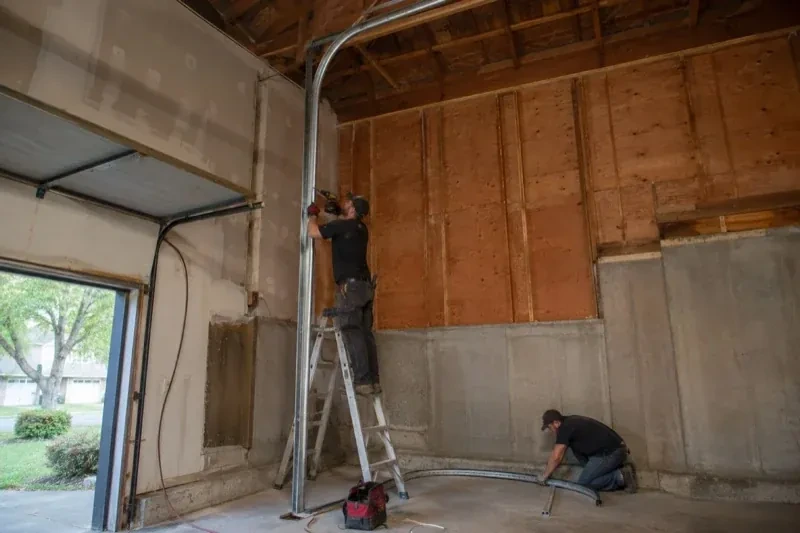
Storage racks were planned near the ceiling, but the existing tracks and centre-mounted opener divide the only practical zone. The wall above the door appears tall enough to move the turning point upward.
High-Lift Garage Door Conversion
In plain words
A vehicle lift and an overhead door can share one bay when their clear zones are designed together. The technician records the lift height, vehicle profile and door travel, then calculates how far the panels can rise before turning. High-lift track, contoured cable drums, longer cables and correctly selected springs guide and balance that new movement. The opener may also move away from the centre ceiling line. Full-cycle checks confirm that the door, vehicle area and building features remain separated through operation.
How the visit goesThe garage has a tall ceiling, yet the horizontal tracks sit much lower than the lights and joists. That unused wall height makes the open door feel like a low shelf across an otherwise generous room.
Stayner
How the visit goes
Map every overhead obstruction
A laser and tape are used to build a three-dimensional picture of the bay. Beams, bulkheads, ducts, pipes, lights, attic access, ceiling slopes and roof framing all affect where tracks and panels can travel. Sideroom and backroom matter alongside headroom, since the raised transition still needs space behind the opening. The map also reserves access around springs, bearings and the operator. With those boundaries recorded, the proposed route can weave through the available volume without trading new clearance for a conflict elsewhere.
Commission the whole converted system
Final work alternates between manual and powered observations. Technicians check that the door stays level, cables remain in their grooves, rollers stay captured, springs clear nearby surfaces and every panel passes through the transition without contact. Manual balance is assessed at several positions, followed by complete powered cycles and safety-function tests. Fasteners, brackets and back hangs receive a final inspection. The installed measurements, component identities, test results and any service notes are then recorded so the conversion closes as one traceable system.
Seasonal observation without adjustment
Temperature and humidity shifts can change lubrication behaviour, door weight and how materials move, while road salt and moisture may reach lower hardware. From a safe position, look for smooth travel, an even bottom edge and cables that remain neatly seated. Listen for a new scrape or repeated contact at the transition. Cleaning accessible track surfaces and following the manufacturer-listed lubrication points supports regular care. Spring, cable, drum and bottom-bracket changes remain technician work because those components carry the counterbalance load.
High-Lift Garage Door Conversion
In the van
- Matched lift cables
- High-lift vertical tracks
- Centre bearing support
- Horizontal track assemblies
- Calculated torsion springs
What affects the quote
Same fees day, night or weekend
1Ceiling and wall obstructions
Beams, ducts, pipes, lights, attic openings and sloped ceilings can change track routing, support placement and the amount of usable clearance delivered.
2Access to the elevated work zone
Ceiling height, fixed storage, vehicle lifts and restricted floor space influence the ladders, lifting equipment, staging and labour needed to reach components safely.
3Framing and attachment readiness
Clear, suitable support points simplify installation; missing blocking, concealed conditions or structural questions create preparatory work and coordination outside the basic hardware change.
High-Lift Garage Door Conversion: questions
What happens to the current garage door opener?
Its compatibility and location are assessed with the new track path. A rail-mounted opener may occupy the clear zone or use geometry that does not suit added vertical travel. Where the existing unit and approved configuration fit, it may remain; otherwise another compatible arrangement becomes part of the scope. Limits, release function, controls and protective devices are tested after mechanical commissioning.
Will the doorway opening become taller?
The conversion changes how the existing sectional door travels inside the garage; it does not enlarge the framed vehicle opening by itself. Its benefit appears when the door is open, because the panels can sit higher above the floor. If the project also needs a taller entrance, that is a separate building and door-sizing scope requiring its own design.
Do the torsion springs change during conversion?
The spring specification is recalculated because track geometry and drum profile change the counterbalance requirement. Door weight, high-lift distance, cable travel, drum dimensions and desired use all inform the selection. Technicians then refine the installed setup through controlled manual-balance checks. Carrying over an old spring solely because it looks serviceable would leave out essential design information.
Installation & Upgrades
- Insulated Steel Garage Door InstallationYour garage is becoming a workshop, but the thin single-skin door rattles, sweats and lets outdoor…
- Wind-Rated Garage Door ReplacementA recent wind event left one section slightly creased, a strut twisted, and several track fasteners…
- Carriage-House Garage Door InstallationThe garage feels dim whenever the overhead door is closed.
High-Lift Garage Door Conversion near you
Our garage door services for Stayner are written up one by one so you can read exactly what happens during the visit. Spring and cable replacement, off-track repair, opener diagnosis, remote programming, weatherstripping, tune-ups, panel replacement and full door installation are all described in plain words.
- Wasaga Beach
- Clearview
- Midland
- Penetanguishene
- Creemore
- Brocks Beach
- New Wasaga Beach
- Oakview Beach
- Oxbow Park
- Firth's Corners
- Portage Park
- Sunnyside
- Dunedin
- Glen Huron
- Singhampton
- Balm Beach
- Coutnac Beach
- Edmore Beach
- Georgian Heights
- Kettle's Beach
- Marygrove
- Ossossane Beach
- Perkinsfield
- Sawlog Bay
- Wahnekewaning Beach
- Woodland Beach