New Doors · Midland
High-Lift Garage Door Conversion in Midland
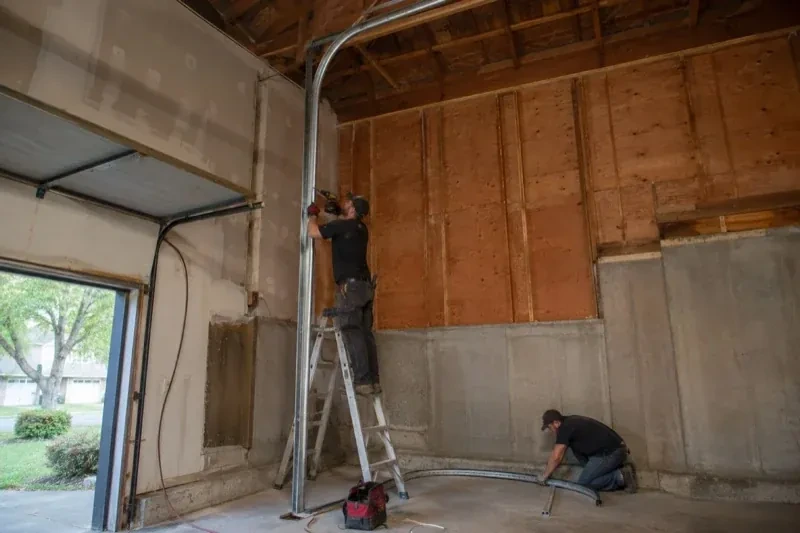
Storage racks were planned near the ceiling, but the existing tracks and centre-mounted opener divide the only practical zone. The wall above the door appears tall enough to move the turning point upward.
High-Lift Garage Door Conversion
In plain words
A high-lift project can often retain sound door sections while changing the hardware that guides and balances them. Their condition, reinforcement, hinges and rollers are inspected first, because the door still has to travel smoothly through a steeper path. New track geometry is paired with drums that manage the changing cable radius, cables of suitable length and torsion springs chosen for the actual door. This selective approach focuses the conversion on the components affected by the new movement while keeping compatible material in service.
How the visit goesA garage project has reached the measurement stage, and overhead clearance is the deciding detail. The current springs, drums and tracks were built for standard lift, while the intended use calls for additional vertical travel.
Midland
How the visit goes
Set a measurable feasibility point
Before components are ordered, the assessment should produce a proposed high-lift dimension and an expected lowest point beneath the open door. Those figures are considered alongside spring room, transition radius, shaft elevation, opener location and future service access. The record also identifies assumptions that need confirmation, such as hidden framing or a planned vehicle-lift height. This gives the customer a useful go-forward decision: a defined clearance outcome, a coordinated parts list and any preparatory work that belongs ahead of installation.
Coordinate the top section through the turn
The top panel has a distinct job as it moves from the wall into the overhead track. Its roller fixtures and position are adjusted to follow the selected transition while keeping the section aligned with the others. Technicians move the door in small controlled stages, watching hinge action, roller engagement and clearance at the header and curve. Where suitable components are required, they are fitted as part of the design. Care at this point helps the door seal when closed and travel smoothly into its raised resting position.
Seasonal observation without adjustment
Temperature and humidity shifts can change lubrication behaviour, door weight and how materials move, while road salt and moisture may reach lower hardware. From a safe position, look for smooth travel, an even bottom edge and cables that remain neatly seated. Listen for a new scrape or repeated contact at the transition. Cleaning accessible track surfaces and following the manufacturer-listed lubrication points supports regular care. Spring, cable, drum and bottom-bracket changes remain technician work because those components carry the counterbalance load.
High-Lift Garage Door Conversion
In the van
- Matched lift cables
- High-lift vertical tracks
- Centre bearing support
- Horizontal track assemblies
- Calculated torsion springs
What affects the quote
Same fees day, night or weekend
1Ceiling and wall obstructions
Beams, ducts, pipes, lights, attic openings and sloped ceilings can change track routing, support placement and the amount of usable clearance delivered.
2Selected high-lift dimension
A modest rise and a layout using most of a tall wall require different track lengths, cable travel, drum geometry, spring design and access planning.
3Condition of reusable sections
Sound panels and hardware may remain in service, while worn hinges, rollers, top fixtures or damaged reinforcement add related work to the conversion.
High-Lift Garage Door Conversion: questions
What happens to the current garage door opener?
Its compatibility and location are assessed with the new track path. A rail-mounted opener may occupy the clear zone or use geometry that does not suit added vertical travel. Where the existing unit and approved configuration fit, it may remain; otherwise another compatible arrangement becomes part of the scope. Limits, release function, controls and protective devices are tested after mechanical commissioning.
Will the doorway opening become taller?
The conversion changes how the existing sectional door travels inside the garage; it does not enlarge the framed vehicle opening by itself. Its benefit appears when the door is open, because the panels can sit higher above the floor. If the project also needs a taller entrance, that is a separate building and door-sizing scope requiring its own design.
Do the torsion springs change during conversion?
The spring specification is recalculated because track geometry and drum profile change the counterbalance requirement. Door weight, high-lift distance, cable travel, drum dimensions and desired use all inform the selection. Technicians then refine the installed setup through controlled manual-balance checks. Carrying over an old spring solely because it looks serviceable would leave out essential design information.
Installation & Upgrades
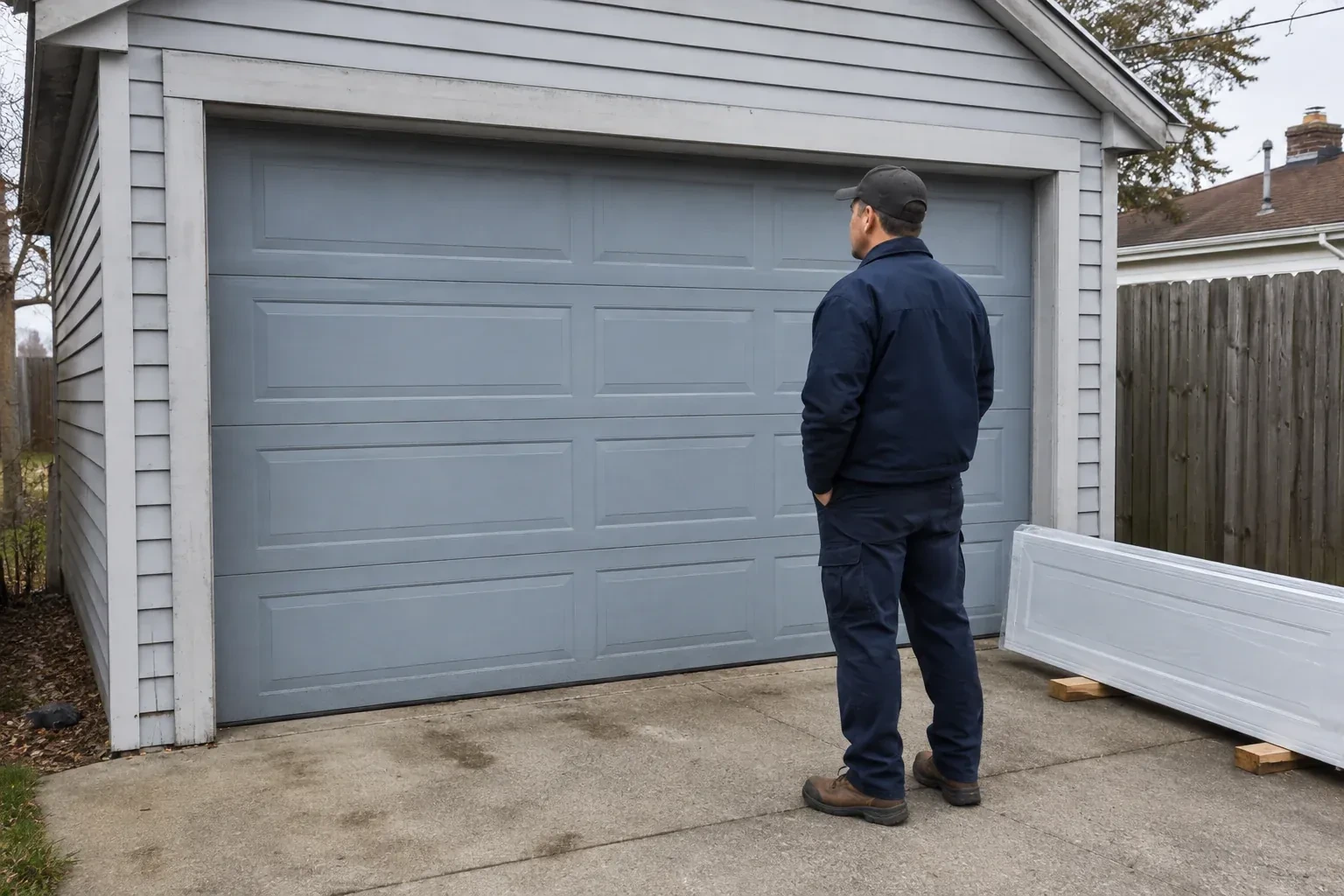
- Insulated Steel Garage Door InstallationYour garage is becoming a workshop, but the thin single-skin door rattles, sweats and lets outdoor…
- Wind-Rated Garage Door ReplacementA recent wind event left one section slightly creased, a strut twisted, and several track fasteners…
- Carriage-House Garage Door InstallationThe garage feels dim whenever the overhead door is closed.
High-Lift Garage Door Conversion near you
A garage door in Midland rarely fails all at once. It gets louder, slower or less even first. Our services are arranged so you can act at any point: a tune-up while it is still working, a repair when something lets go, or a replacement when the door has earned its retirement.
- Wasaga Beach
- Clearview
- Penetanguishene
- Creemore
- Stayner
- Brocks Beach
- New Wasaga Beach
- Oakview Beach
- Oxbow Park
- Firth's Corners
- Portage Park
- Sunnyside
- Dunedin
- Glen Huron
- Singhampton
- Balm Beach
- Coutnac Beach
- Edmore Beach
- Georgian Heights
- Kettle's Beach
- Marygrove
- Ossossane Beach
- Perkinsfield
- Sawlog Bay
- Wahnekewaning Beach
- Woodland Beach